Free guide · Bay Motors, Hayward
Brakes: what your car is telling you
Read your own brakes before anyone touches them.Including ours.
No charge, no catch, nothing to fill in Find your symptomHow urgent is it
Three signals, and we give them the same weight on this page. Some of these mean stop driving. Several do not, and telling you which is which is the point of the guide.
| What you notice | What it usually means | How much time |
|---|---|---|
| High pitched squeal when you brake | The wear indicator is doing its job. A small metal tab is touching the disc because the friction material is getting thin. | Book it this week |
| Squeal on the first stops of a damp morning, then gone | Light surface rust on the discs from sitting overnight. The pads wipe it off in a few stops. | Normal |
| Grinding, scraping, a low metal rumble | The friction material may be gone and steel may be touching steel. Further driving can damage the discs and reduce braking performance. | Park it and call |
| Pedal pulses or shudders as you slow from speed | Uneven disc thickness. The disc is fractionally thicker in some spots than others. | Book it this week |
| Steering wheel shakes when you brake, pedal feels fine | Same root cause, usually the front discs. Can also be a tire or a suspension part, so it gets checked properly. | Book it this week |
| Pedal feels soft, spongy, or travels further than it used to | Air or moisture in the fluid, or a leak in the hydraulic system. Fluid does not compress. Air does. | Treat as urgent |
| Pedal slowly sinks to the floor while you hold it at a light | The master cylinder is bypassing internally. Fluid is slipping past a seal instead of holding pressure. | Stop driving |
| You have to pump the pedal to get a firm one | Air in the lines or a failing hydraulic component. Your brakes are working on borrowed margin. | Stop driving |
| Car pulls to one side when you brake | One side is clamping and the other is not. A seized caliper, corroded slide pins, or a collapsed hose. | Book it now |
| Pulling, a burning smell, and one wheel hot after a drive | A brake is dragging and not releasing. That corner is cooking. | Book it now |
| Red brake warning light | Check the parking brake is fully off first. If it is off and the light stays on, the brake system needs prompt attention. | Park it and call |
| Amber ABS light on its own | A fault in the anti lock system, often a wheel speed sensor. Your normal brakes still work. You have lost anti lock assistance. | Book it this week |
| Red brake light and amber ABS light together | Two systems reporting at once. This is treated as a genuine hydraulic and control fault. | Stop driving |
Found your symptom?
If you landed on a red row, park it and call us. For a yellow row, call or text us with the symptom and your vehicle year, make and model. We will start with what you are noticing, not a guess.
What the number on the sheet means
Every brake inspection ends in a millimeter reading. This is the part nobody shows you.
- 12 mmA new pad. All of the friction material is still there.
- 7 mmHalf worn and doing its job. There is nothing to do here but keep driving.
- 3 mmThe wear tab reaches the disc. The squeal in the first row of the table above is this, and the car is making it on purpose.
- 0 mmSteel backing plate against the disc. The disc is being cut while you drive, so the job grows from pads to pads and discs.
Ask any shop for the millimeter reading, ours included. A number you can check beats a word like worn, and it tells you whether you are booking today or in four months.
Three things worth knowing
These are the ones that save people money.
A pulsing pedal needs a real explanation
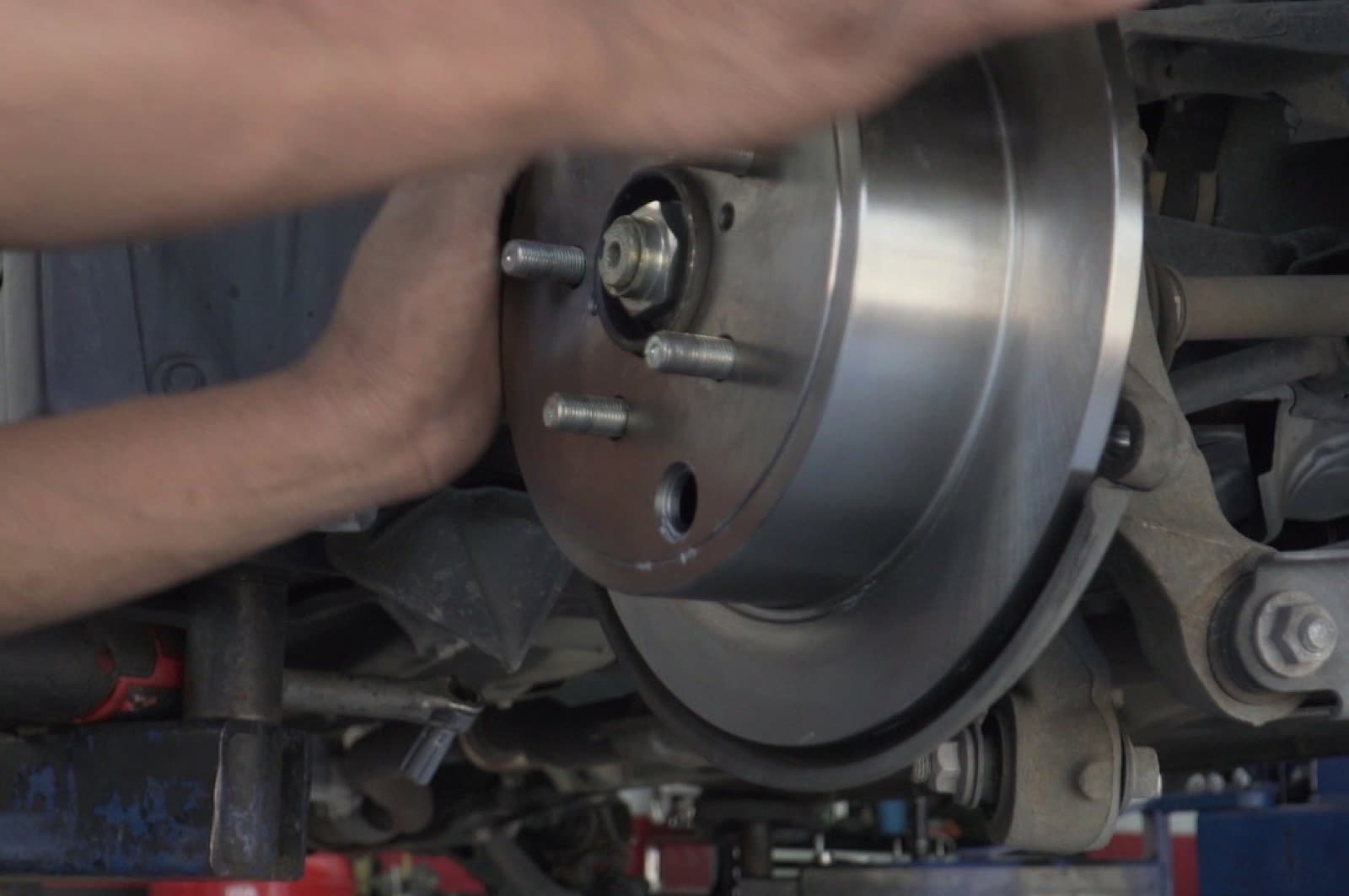
Pulsing commonly comes from uneven disc thickness. Rust or debris on the hub face can contribute. Ask whether the disc and hub face will be inspected, cleaned and measured so the cause is addressed, not only the symptom.
Ask to be shown the wheel
Rear drums and rear discs are different jobs at different prices. Plenty of Civics, Corollas and Fits run rear drums. If a quote does not match what is actually on your car, ask the shop to show you the wheel. Trim and market both change the answer, so a quick look beats a chart.
Do not use silence as an all clear
If a squeal goes away but later becomes grinding, book it right away. Brake noise can change as pads wear, so a change in sound is worth checking.
Do you even have rear discs
Worth knowing before you read anyone's quote, ours included. US market cars. Trim changes the answer, so if yours is not listed, or it is an import, ask to be shown the wheel.
| Car | Rear setup |
|---|---|
| Civic, 2012 to 2015 | Drums on LX, HF, Hybrid and Natural Gas. Discs on EX, EX-L and Si. Price is not the guide here: the Hybrid costs more than an LX and still has drums. |
| Civic, 2016 and newer | Discs on every trim. Honda called four wheel discs a first for the Civic that year. |
| Fit, 2015 to 2020 | Drums on every US trim, Sport included. Japanese market RS cars came with rear discs, so an import can differ. |
| Corolla, 2014 to 2018 | Drums on L, LE, LE Eco and XLE. Discs on S, SE and XSE. |
| Corolla, 2019 | The sedan follows the 2014 to 2018 split. The new-generation hatchback has discs on every trim. Check sedan or hatchback before drawing a conclusion. |
| Corolla, 2020 and newer | Discs on every trim, including the base L and Hybrid. |
| Corolla iM, 2017 to 2018 | Discs, despite not being a sport trim. |
| RAV4 | Drums 1996 to 2003. Discs from 2004 on. Some rear-disc RAV4s still use small parking-brake shoes inside the rotor hat, which does not make them drum-braked cars. |
| Sienna | Drums 1998 to 2003. The 2004 to 2007 range can be either, depending on trim, AWD and stability-control equipment, so look at the actual van. Discs from 2008 on; rear parking-brake shoes can still sit inside the rotor hat. |
| Tacoma | Drums through 2023, every trim including TRD Pro. Discs from 2024. One rear drum part number covers 2005 to 2023. |
Bring another shop's quote
If you already have a quote from somewhere else, bring it in. We will put eyes on the car and tell you straight what matches what we see and what does not. If the answer is that you do not need the work yet, that is what we will tell you.